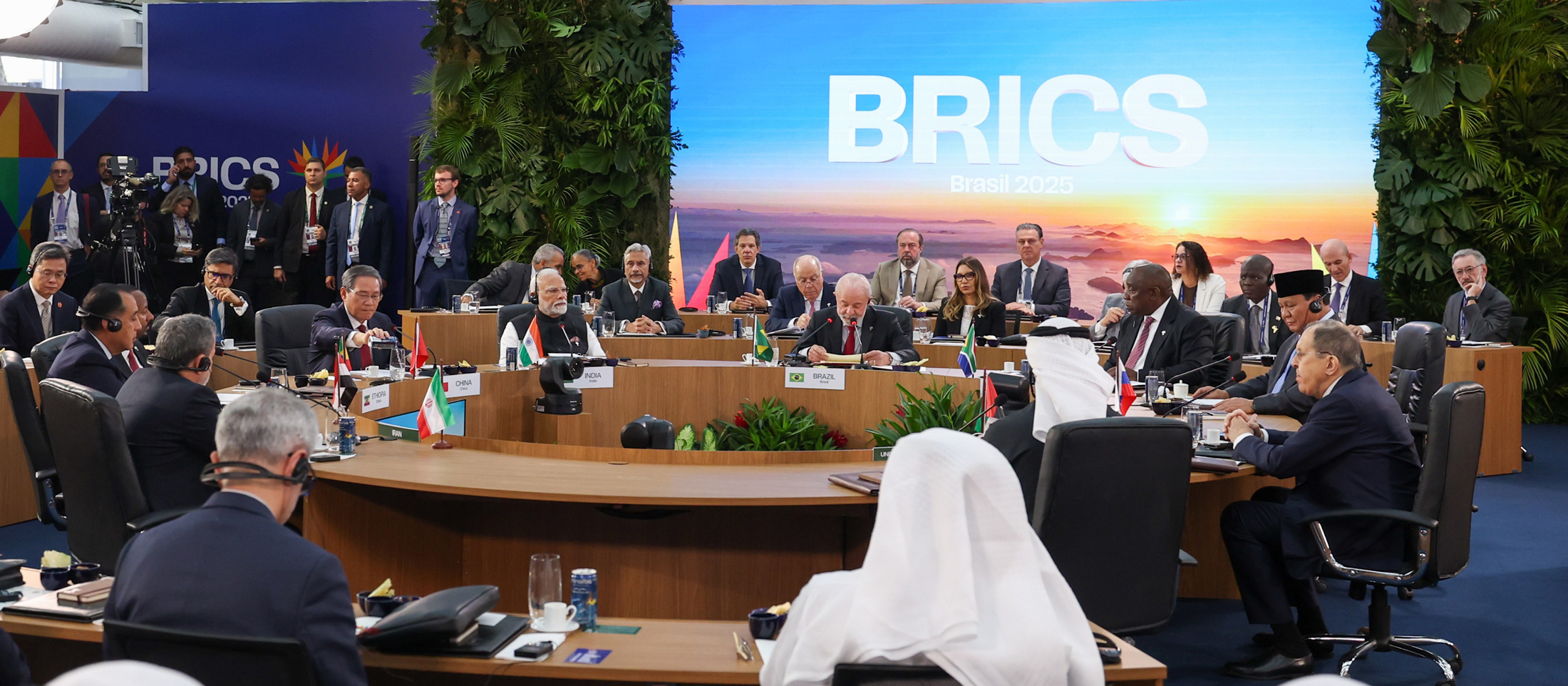
At the two-week COP30 gathering of the world’s climate negotiators in Belém, Brazil — in the cradle of the Amazon — a profound tectonic shift in climate diplomacy is under way. The world’s previous centre of gravity, the United States, has formally opted out of sending senior officials to the summit, leaving a vacuum. The Indian Express+4The Guardian+4The Washington Post+4 Into this vacuum steps the bloc of emerging economies known as BRICS (Brazil, Russia, India, China, South Africa and partners), making clear that the “Global South” intends to lead a new chapter in climate action. But the question looms large: are they ready, willing — and capable — of filling the breach?
As negotiations open in Belém, two contrasting narratives collide. On one side lies the US decision to stay on the sidelines — a pointed rebuke of the multilateral climate regime — and on the other a determined BRICS effort to take the helm of global south-driven climate governance. For vulnerable countries facing escalating floods, droughts and forest loss, the stakes are immediate. The long-term outcome, however, could reshape climate leadership for decades.
US Withdrawal: A Signal with Consequences
The withdrawal of a high-level US delegation from COP30 marks a dramatic departure from past practice. From the first days of the Paris Agreement to the most recent sessions, the United States has been a significant, if sometimes inconsistent, presence. This time, senior officials will not participate. The Guardian reports: “The United States has confirmed it will not send any high-level representatives to the upcoming UN climate talks in Brazil.” The Guardian
Why does this matter?
The US remains the highest cumulative emitter in history, and its policy pivots ripple globally. The Washington Post+1
Its absence leaves a moral and diplomatic vacuum: during an earlier summit in Belém’s lead-in, the UN Secretary-General declared the failure to limit warming to 1.5 °C “a moral failure and deadly negligence.” The Guardian
Key climate decisions hinge on global consensus, and major players opting out risk undermining trust in the process.
At the heart of the US decision lies a broader political realignment: the current administration frames climate multilateralism as an economic liability, as one Washington Post article puts it:
“President Trump will not jeopardize our country’s economic and national security to pursue vague climate goals that are killing other countries.” The Washington Post Meanwhile, the US lobbied actively to derail climate initiatives — for example, by threatening sanctions if other states backed a global shipping-industry carbon price. The Washington Post
Rather than conforming to the international climate regime, the US appears to favour bilateral energy deals and fossil-fuel trade. On the edge of COP30, this withdrawal has drawn rebukes:
“Mr Trump is against humankind,” said Colombia’s President Gustavo Petro at the summit. Politico+1
Still, some analysts argue the absence may paradoxically permit smaller, freer negotiations:
“Without the US present, we can actually see a real multilateral conversation happening,” said Pedro Abramovay, a former Brazilian official. ThePrint+1
But the cost of this ‘greater freedom’ is the dissolution of the old climate architecture — the regime built around US leadership, northern finance and global north-south frameworks. What comes next remains uncertain.
BRICS Reboot: Stepping into the Void
The BRICS bloc, under Brazil’s presidency in 2025, has seized the moment. At its Rio de Janeiro summit in July the group adopted a “Framework Declaration on Climate Finance”, laying out a roadmap for emerging economies to mobilise capital, deepen carbon accounting, strengthen trade–climate links and support a “developing country-led platform”. brics.utoronto.ca+2Vision IAS+2
Key highlights from the BRICS Rio Declaration:
A call on developed countries to deliver “adequate, predictable, affordable, concessional” climate finance to developing nations. Vision IAS+1
Recognition that fossil fuels will still play an important role in emerging economies’ energy mix. Wikipedia+1
Support for Brazil’s proposed Tropical Forests Forever Facility to preserve rainforest ecosystems. Reuters+1
A claim to offer new leadership from the Global South: “major emerging economies can step into a global leadership role to address the climate crisis.” wri.org
In other words, BRICS is declaring: “If the West won’t lead, we will.” A commentary by the Lowy Institute puts it plainly:
“As the US withdraws from the Paris Agreement and EU shifts focus, developing nations seek new multilateral forums for climate action.” lowyinstitute.org
Yet this ambition carries weighty challenges.
Why the Gap Matters for the Global South
For the so-called Global South — vulnerable countries in Africa, Asia and Latin America — the stakes of climate action are existential: rising seas, shrinking crops, more intense cyclones and heatwaves. According to the World Meteorological Organization, 2025 is likely to be the second- or third-warmest year on record, with global mean temperature through August at +1.42 °C above pre-industrial average. ThePrint+1
Key implications for the Global South:
Finance shortfall: Developed countries committed to mobilising US$100 billion per year by 2020; the target has not been fully met, and the next live target is US$300 billion per year by 2035. Vision IAS+1
Technology transfer and capacity building: These remain bottlenecks for implementing low-carbon pathways and adaptation strategies.
Justice and equity: Countries less responsible for historical emissions demand a fair space to grow, even as they transition.
Institutional reform: Emerging economies increasingly view global governance (climate, finance, trade) as lagging their realities. For example, BRICS are calling to reform the International Monetary Fund and other institutions. Reuters
In this context, the US departure creates both a danger and an opportunity. A danger in that global north leadership is weakening; an opportunity in that emerging nations may advance a new architecture more attuned to their needs.
Can BRICS Deliver? Three Hurdles
While the BRICS bloc is positioning itself boldly, translating ambition into action faces structural headwinds:
1. Internal heterogeneity The BRICS countries (plus partner states) span the spectrum: China is the largest emitter and a major industrial power; India is a rapidly growing economy balancing development and emissions; South Africa and Brazil are more vulnerable and have weaker fiscal capacity; Russia remains heavily dependent on fossil fuel exports. Harmonising policy across such diversity is complex.
2. Finance: promise vs. scale The Framework Declaration sets path-breaking rhetoric: mobilise financing, reform multilateral banks, deploy blended finance, and scale climate investment. brics.utoronto.ca+1 Yet the actual mobilisation of tens or hundreds of billions remains uncertain. For instance, Brazil’s Tropical Forests Initiative offers promise, but details on donor commitments, private-sector leverage and governance remain vague. The Guardian+1
3. Normative credibility and fossil-fuel role While BRICS speak of climate leadership, they also acknowledge fossil fuels will continue to play an important role in emerging economies. Wikipedia+1 That raises questions of credibility: Can they credibly lead a transition while building fossil-fuel infrastructure? Moreover, they will need to reconcile economic growth with emissions control — a tension decades in the making.
These three hurdles — diversity, finance, normative credibility — may determine whether BRICS is a riser or merely a claimant in climate leadership.
Evidence of Momentum
Despite these challenges, some concrete signs indicate that BRICS is not merely talking.
In May 2025, BRICS envoys approved a landmark document on climate finance. The guidance urged reforming multilateral development banks (MDBs), increased concessional financing and mobilising private capital for climate action in Global South countries. cop30.br
At the July Rio summit, BRICS flagged the role of emerging economies in climate governance and pushed for reform of financial institutions. Reuters+1
In the run-up to COP30, BRICS adopted language on improved carbon accounting, green bonds, technology transfer and a new developing country-led platform aligning trade, climate and finance. wri.org
For example, consider India’s role: as one of the BRICS members, India is already setting strong domestic targets, increasing solar capacity and pursuing international collaboration. Its participation gives credence to the bloc’s climate ambitions. Similarly, Brazil’s Amazon stewardship and Brazil’s push for the Tropical Forests fund gives ecosystemweight to the emerging south agenda.
Moreover, the absence of the United States may enable new coalitions of the willing: smaller groups of countries aligning regionally and thematically may more easily form without the weight of old paradigms. The Reuters coverage put it this way:
“With the US out, we can see a real multilateral conversation.” ThePrint
In short, we see momentum — but the scale, durability and coherence of that momentum remain to be proven.
Case Study: Brazil’s “Tropical Forests Forever Facility”
A useful micro-lens to examine BRICS’s climate ambition is the Tropical Forests Forever Facility (TFFF) proposed by Brazil ahead of COP30. It aims to mobilise US$125 billion over three years for forest conservation and carbon sequestration in tropical countries. Reuters+1
Key features:
Seed funding from Norway and France already pledged (about US$3 billion and €500 million respectively) as early stage financiers. Reuters
Leveraging private capital: Brazil expects private-sector investment to multiply public seed funds.
A global south-led model: the facility targets rainforest nations and emphasises stewardship over forest ecosystems, not just emissions reductions.
Implications:
If successful, it provides a blueprint for south-led climate finance beyond the donor/recipient logic of the north.
It links equity and nature preservation with finance, a long-time demand of frontline states.
It also tests the capacity of BRICS to engineer new institutions and mobilise capital at scale.
Yet, the facility faces risks: fundraising remains uncertain; governance and transparency systems are still being designed; and private-sector involvement may bring its own pressures. Whether TFFF can scale and sustain will be a key test of BRICS-driven climate architecture.
Global South Leadership: What It Requires
To genuinely lead climate action, the emerging coalition must deliver on several fronts:
A. Mobilise finance at scale The Global South will need access to billions annually, for both mitigation (reducing emissions) and adaptation (coping with climate impacts). The BRICS Declaration themselves underline the need for developed countries to honour their historic responsibilities and for new sources of finance and instruments. brics.utoronto.ca But converting declarations into disbursed, effective finance will require:
Reform of MDBs and national development banks to lower costs of borrowing for emerging economies.
Transparency and governance frameworks to ensure credibility, avoid green-wash and attract capital.
B. Build productive capacity and technology transfer Emerging economies must not only receive finance, but also the technologies and institutional capacity to deploy renewable energy, carbon capture, resilient infrastructure and low-carbon industrialisation. The framework emphasises this — the BRICS Statement calls for technology transfer, capacity building and affordable green finance. MEA India
C. Reframe energy transition for development For many Global South countries, energy access, economic growth and poverty eradication remain urgent. The challenge is to align climate goals with development imperatives. Recognising that fossil fuels will continue to play a role is politically honest, but transition trajectories must be credible, time-bound and aligned with low-carbon pathways. The BRICS Declaration’s acknowledgement is an important evolution. Wikipedia
D. Strengthen institutional leadership and governance Leadership here is not just speaking, but convening, coordinating and delivering. BRICS will need to build or partner in institutions that can:
Set credible targets and monitor results;
Bring together finance, trade, energy and climate policy coherently;
Represent Global South countries in UN and multilateral negotiations;
Offer alternative pathways and models (rather than replication of north-led models).
E. Secure legitimacy and voice in global negotiations In the absence of US leadership, the Global South must avoid occupying an institutional vacuum. Credible leadership will require clear positions, transparent frameworks and delivery. The world will watch not just what BRICS declares — but what it does. As the WRI noted:
“This year’s BRICS summit sends the clearest signal yet that major emerging economies can step into a global leadership role … even as the United States retreats.” wri.org
Risks and Obstacles Ahead
Despite the potential, several risks could derail BRICS’s ascent as climate leader:
Fragmentation within BRICS and between Global South actors: Conflicting national priorities, degree of industrialisation, fossil-fuel dependencies and geopolitical alignments may weaken cohesion.
Accountability and follow-through: Declarations are only credible if backed by implementation, measurable targets and transparent governance. Without that, rhetoric risks becoming symbolic.
Finance gaps: Mobilising private capital is notoriously difficult in emerging markets; concessional finance remains limited; pressures on domestic budgets may compete with climate commitments.
Green-growth paradoxes: Many emerging economies still rely on extractive industries for growth and revenue. Balancing that with decarbonisation will require major policy shifts, structural reforms and new sources of growth.
Global governance push-back: Established institutions and northern states may resist transfers of leadership or new frameworks that dilute their influence. For example, BRICS critiques of carbon-border adjustment mechanisms (CBAMs) and other trade-linked climate policies raise tension. Reuters
If BRICS stumbles, the global climate architecture risks fragmentation: multiple regional frameworks, competitive rather than cooperative pathways, and slower collective progress toward the 1.5 °C goal.
What’s at Stake for India and Other BRICS Countries
India, as a rapidly growing economy, sits at the intersection of ambition and vulnerability. The energy transition is key to its economic future, and its participation in BRICS gives it both influence and responsibility. For India, success means: leveraging climate action for renewable energy growth, investment in green infrastructure, and technology collaboration — while ensuring equitable development for hundreds of millions still lacking reliable electricity or energy access.
Similarly, Brazil carries rainforest-ecosystem responsibility; China carries manufacturing and clean-energy leadership; South Africa and others carry climate-vulnerability imperatives. If the BRICS bloc can knit these diverse national interests into a coherent, south-centred climate governance framework, they will have made a lasting shift.
The Stakes at COP30
As COP30 opens in Belém, the set-up is unusual. The absence of a major northern power, the gravity of the Amazon setting, and the real risks of climate failure meet in a potent mix. Key deliverables include:
Agreement on how to ramp up climate finance flows.
Mechanisms for fair carbon accounting, especially for emerging economies.
Forest and nature-finance commitments (e.g., the TFFF).
Trade and climate linkages: how sustainable trade regimes and technology transfer align with climate objectives.
It will test whether the emerging south-led architecture can act — not just talk.
Expert Voices
“Without the United States’ presence, the field is open — but open for what? BRICS can lead, yet leadership means delivery not just rhetoric.” – Dr Ramanan Lal, climate policy analyst. “Emerging economies are ready to play a greater role, but they will also ask: why should we accept emissions limits first when we still must develop?” – Prof Lakshmi Narayan, South Asia environmental governance expert. “The finance gap remains the key. Mobilising private capital is harder than signing declarations. That will be the real test for BRICS.” – Ms Priya Menon, sustainable finance advisor.
From Potential to Practice
The story of COP30 may mark a turning-point: the old paradigm of climate leadership grounded in the Global North may be giving way to one anchored in the Global South. The BRICS bloc has seized the moment to present itself as architect of that new paradigm. But being the architect and being the builder are very different.
To move from potential to practice, BRICS must: mobilise real finance, deliver credible technology transfer, create institutions with legitimacy and transparency, and align growth and climate in emerging economies. Absent those, the risk is silence masked as leadership, and fragmentation clothed as innovation.
For India, Brazil, China and other BRICS states, COP30 will be more than a summit — it is a test of whether the Global South can lead not just its fate, but the world’s. In a world where a 1.5 °C limit has already become a “moral failure” to even attempt, as the UN Secretary-General put it, the question is: will this new south-led coalition act — or will it become a reactive echo of past regimes? The Guardian
The next few months will show whether the Global South can pick up the gloves. Because if it doesn’t, the cost will not just be institutional: it will be ecological, economic and human.